
The awful daring of a moment’s surrender.[1]
O God turn me into a flower.[2]
†
†
Let us reexamine why the poets name April as the cruelest month. It provides a certain contrast, peculiar in its cruelty, when the world around you is raised to new life, when spirits are rekindled and desires fulfilled, when flowers blossom in the garden but you yourself slip back into black waters; you stand trapped in the mud. And all manner of things which were thought to be buried come sprouting up out of the soil.
†
Spring in Manhattan announces its presence with a bilious, bewildering cough of enchantment, a lazy drifting of cherry blossoms between tracts of transportation, heaving in time to gilded Gershwin melodies. Moving to this city without connections, with no preconceived notions or idealistic disillusions apart from a vague sense of its tangled historic web and its position as the pulsing, sputtering brain of America, still strikes me with waves of grotesque unreality. Even now I am flooded with the shapeless emotion of relocation. How did I get here? How did this happen? Yet there is the Statue of Liberty silhouetted in sunfall as I go running across the Manhattan Bridge. And there is the great sprawling mass of it all as I am swallowed back into the labyrinth.
Two months prior, when I crossed its threshold without any expectations, I found myself rooted fast in a love for the twist of its brownstone mazes and the thrum of its neon blood. And where before I’d tried so long to find a corner of some city where I felt like I belonged, here was a place that seemed a home for all aliens. Between sleeping carousels and streets Jesuses, dancing rats and a tangle of angels, it ushered me to a world of people just as hungry for the small sparks of connection found in the temporary nature of our shared encounters. Not since the European cities of my childhood had I heard the voice of a place so audibly asking me to stay—whether in the wind, rustling light on a sea of towers; in the music that writhes around street corners, screaming, sighing, bleeding back into stillness and harbored memory; in the current of beautiful strangers who surge from their inexhaustible well of anonymity to board each train car and disappear eternally; or in the language winding multi-layered among sidewalk passengers, community woven unspoken on their harsh but resolute steps. My sense of belonging found the flow familiar, adapted unexpectedly but without question. Here finally was a place that moves at the pace of my own mind, a place to hold me always at the teeming edge of life, boots hounding the pavement, thoughts shaping the chorus of traffic and the carnage of street art into a lifeblood. For I too have marveled at the maze in its complexity, in its seemingly lawless rhythms—then run its rows unfazed with the deeply growing conviction that I could not rest my mind, my tumultuous, ink-bleeding dreams until I called it all my home. It bears such a hunger; it begged for my heart. And I, gladly, surrendered.
I am still attempting to realize both the enormity and the unremarkable quality of what I have done. To move to a new state? So what. To have escaped at last! I am drunk on bliss. I am enthralled. Anxiety seeps up through the ground, emanates off every window. Have I brought myself here just to fail? What have I done what have I done. I will the subway passengers not to throw more than the customary glance of acknowledgement. I am an imposter; if they look too close they’ll know. I may dress the part, may walk faster than everyone else, may keep the customary face of nonexpression—but surely they will find some fissure in the façade. I can’t belong here, can I? I belong here. I have never lived here. I live here now. I don’t belong here I don’t belong here.
Stay with me, the city whispers. Stay with me and I will give you all that you’ve dreamed so long of obtaining. Get out! the city screams. Who are you to think I should have any space in this too-full heart for you? You want to stay? Let me make you a part. Here is the cog where you belong. You do not want to fit? I will make you fit. Stay with me. Such a pretty machine, aren’t we? Here’s your slot in the factory. Stay here. All so polarizing. And I cannot rest. I want so badly to embrace it all—to be embraced by it. Better check your powers of romanticism, boy, say the eyes of the man crouched on the corner sidewalk. For though your mind is sure, your footing is not as strong. So much of this battle is beyond your little idea of control.
It is these times in our lives when everything comes into question. Everything held under the glass and examined. Your finances, your career, your talent, your place as an artist, your history of love, your physical appearance, all of it. Is this part of the inevitable process of reinventing yourself or just a byproduct of the isolation? Your sense of place is upended, your sense of self then questioned—and all the ghosts of the past, however minimal, come bobbing up to the surface.
These, I found, are only combated by the fragments of novelty quietly swarming the everyday life, whether candles glowing on the scarred wood planks of the bar or bottles from Tbilisi in the Elizabeth St. wine shop. A menagerie of mythological statues sleeps in my favorite garden, and someone in St. Thomas Church plays the organ to an empty cathedral. I play a game of eye tag with the subway stranger in the green jacket. His shades shielding the fluorescents, arm hooked around a potted plant. Words thrown in wordless glances, glances thrown between closed doors. A mason jar cradles a single rose, thrown at another ethereal concert. “One day in New York is two years’ worth of experiences.” [Weyes Blood. Brooklyn Steel. 2023.] I have lived it firsthand. If not sketching a steeple in Lexington Ave. then scrawling away the hours from a coffee shop that’s been around since 1927. Stained glass panels blaze in the sun of the outdoor subway station, existing for no other reason but to be admired by the passing strangers. All the grit and the grime take on a hue of the glittering and golden. It crafts an abstract, sad sort of song. And the night dissolves around us. But there is no us. It is I who am dissolved into the night.
†
Last night, stepping out of Penn Station, the Empire State surged ominous in the mist, conjured right out of the pages of The Crack-Up I had just been reading on the train. “Wrapped cool in mystery and promise” if only to confirm that I too “was compelled to live in [the city’s] disordered mind.” Carvings of emotionless women graced the buildings—raising torches in welcome or as warning signs? “O glittering and white! …from the ruins, lonely and inexplicable as the sphinx, rose the Empire State Building…” [F. Scott Fitzgerald, “My Lost City,” 1935-1936].
I rip through the fabric of time itself. I convene with the dead. Add Zelda and Scott to the host of ghosts wisping along the avenues. Finding leftover ribbons of Kerouac scrawled in the bathroom stall. Peter Hujar’s dark-windowed loft gaping over the traffic of the East Village. If I am a professional at anything, it is being a shadow at the edge of the wall, a pair of eyes painted on the billboard. The press of people, at times repulsing, matched by the absence of any personal connections, crests and ebbs and this foundation of wandering settles where? Time winds in loops. Why do I feel like I’ve already been here, when everything is new? Words spin vacantly in the air like half-seen, unfolding tentacles. I grasp at their dangling threads.
†
Now from this distance, sitting in Domino Park, the Empire State looks little more than a rather ominous syringe. This city will give you your medicine, oh yes. It will provide you with the drug, will craft the simulation that forces you to face yourself. To find out what it is you value, what it is you’re made of. What will the labyrinth make of me? What does the monster make of the man?
The monster is a metropolitan opera exhaling its arias in a brass vibrato of souls who are prettier, wealthier, pluckier, trendier, technologically savvier, and spiritually healthier than you are. They are inaccessible. They are untouchable. Shrouded in immaterial veils of identity [or material veils if their identity is founded in material wealth], they press in, press close. Look at me. Look at me. Don’t. Touch. The silence suffocates.
I can’t help but feel that these influencers confined to the unreality of their social mediums are just like the little dogs I saw pissing in Madison Square Park. They truly believe another won’t trot behind them two minutes later and capture or ‘mark’ the exact spot they just planted their little stamp of creative ownership on. We horde the real world as much as we can. We turn it into a power plant. On the subway, the technicolor models in the dating app ads start singing in time to the music floating out of my airpods. On Fifth Ave, I pass a life-sized tyrannosaurus rex made entirely out of designer handbags. An ancient brick bookstore only four stories tall stands amid a garden of steel towers like a symbolic middle finger. New York City delights and disgusts, while all her buzzing children clip clip clip across her streets like little pampered dogs. Take this mosaic of madness for what it is. Yes, I do believe Mr. Eliot would have been as horrifically fascinated by the yassification of my generation’s culture as I am.
†
Paths divulge, converge again. Every day becomes a choose-your-own-adventure with seemingly lifelong but yet untraceable consequences. Signs and symbols converse. I keep seeing a startling number of dead birds. Jack said he takes them as good omens, but between you and me, each time I see one it’s always followed by some small measure of catastrophe. What are you currently holding on to? they ask. Prepare to let it go.
If every door opened when I needed it to, this wouldn’t be a labyrinth. A maze, by nature, requires solving. And no way out is reached without learning what corners not to turn down, what passages not to take. Bridges, tunnels, corridors of steel—everything here suggests passageways, all connected tissue of the maze. Cellars, stairs, black doors in the ground—twisting into darkness. In the short time I’ve lived here, I still have yet to climb higher than a second story. All that grandeur, but I am a creature of the underbelly. I am Theseus, making his way through the tunnels of Crete. The horned beast sleeps somewhere beneath. What will the beast prove to be? Oppositional circumstance? My own insecurities? My pride or my prejudices?—toward those with wealth or beauty or tangible families, those who have what I should want? Or is the beast the inherent nature of the city itself? The concrete gauntlet where every day is a fight for space, a fight for survival, a fight for the right to a seat at the table.
Then in this myth of myself, what is the conquering sword?—whose is the red thread of Ariadne, gifted to trace the way through? Is it made out of my own words, or are these the tools left by others? Remnants of the ghosts we chase, their pieces of art serving as some kind of map at best. Our steps run across the parallel tracks of present and past, decades piling on top of each other like layers of lace over a deep well of experience. Maybe this guiding thread is made up of the words of all us, as we continuously weave strands into its course. Maybe we are both the resourceful maiden and the stumbling hero.
“Loneliness, I began to realize, was a populated place: a city, in itself. And when one inhabits a city, even a city as rigorously and logically constructed as Manhattan, one starts by getting lost. Over time, you begin to develop a mental map, a collection of favoured destinations and preferred routes: a labyrinth no other person could ever precisely deplicate or reproduce.” [Olivia Laing, The Lonely City, 2016.]
I rock between waves of self-pity and some misplaced notion that the isolation in such a populated place, a place which seethes its current against those without the standard set of resources [and no failsafe and no undernetting; and no backups and no magical contacts]—will unlock some strengthened sense of endurance or the conditions by which to birth some fantastic work of art. Is it all a farce? I can stir the waters of despair or still them to reassuring ripples any number of times in a single day. It never alters the weariness, the aggravation of bearing all the change, the motion of the tide alone and adrift.
†
[It is at this turn in the labyrinth that the floor gives way beneath the feet of our already stumbling hero. He lands akimbo before the stamping hooves of the maze’s horn-crowned monster. And the monster is a landlord who demands double the monthly rent just a week before it’s due. And the monster is our hero’s inability to meet such a demand, nor change the iron will of such avarice, dragging in its fist the hot stab of realization—that he will have to leave, that he will not be allowed to stay. And the monster is the celebrated callousness of the city, which turns its face to the clouds as it passes his reeling shape. If only you were one of the pretty boys, it says. Perhaps then you’d have found some glittering circle to stand in. If only you were better connected. Perhaps then you’d have some viable options. If only you were wealthier— Did you forget? This city always demands more than what you have, more than what you’re prepared to give. If only you were as plucky as you believe yourself to be. Perhaps then you’d rouse some final advance, find the hidden lever that will hissss—click! the magic way out. If only. If only. If only.]
The sounds of the city swallow any cry for help. Any maps I might have traced on the pages of a few select books [whether left by disillusioned jazz babes or an empathetic memoirist, collecting the hearts of New York’s loneliest artists] wrinkle and melt and clamp shut. And no voice cuts through the gloom, only a mad chorus of voices, consuming in its patterns of incomprehension. And what I thought would be a prelude is only a single mad and glorious jazz concerto. “And what you thought you came for is only a shell…” [T.S. Eliot, “Little Gidding,” 1942.]
How quickly a place you once felt full of opportunity and promise, acceptance and belonging becomes a winding tunnel of expulsion and deception. A corridor of closed doors, guarded by the evil twin of serendipity. A glittering tableau of collapse, where you may drown in the sparks of a spectacular disaster or take the ferryboat out and live—live!—but remain adrift, in the dark, in the silence.
I feel as one caught dancing on their grave before they’d even been buried in it. I heeded the poets’ warning, I did. I was careful. I knew I wasn’t in Wonderland. It didn’t matter. Brought here just to kill my darlings once more. The little death that creeps across my universe. Death by misadventure. Death to what I hold most dear. Throw it on the altar that you built with your own two hands. The poeticism must be justified. And the world is made of poetry; it is only fair.
†
“The progress of an artist is a continual self-sacrifice, a continual extinction of personality… What happens is a continual surrender of himself as he is at the moment to something which is more valuable.” [T. S. Eliot, “Tradition and the Individual Talent,” 1919.]
“Nobody can survive with the personality that they want, which is the hero of their own drama. That hero dies, it’s massacred, and the self that is reborn remembers that crucifixion. And we’re doing that every day.” [Leonard Cohen, MUSICIAN magazine, 1988.]
†
†
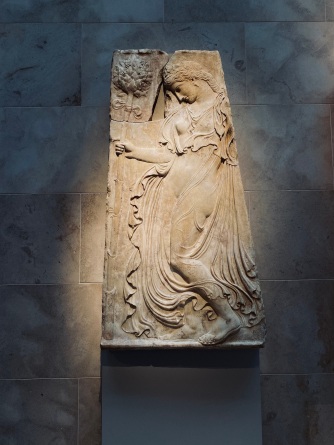
If April is the cruelest month, imposing harsh contrast, flowering in cycles of violent rebirth, let us too revisit the goddess of springtime. A year ago, I felt it was her annual return to the underworld that invoked the sighs of a heavy soul. But I begin to understand—she suffers more the endless split; and she brings now, with her blossoming season, the dividing lines of my own life into clearer focus. I too live a half life. Not in that I’ve been living half a life, but in that my life is always half of one thing and half of something else. I am always tracing the dark rift that crawls, that forks between my sense of home in a fixed place and my sense of home as something ever in motion; between my spirituality and my sexuality; between a childhood stretched across both America and Europe; a body held in the present but a soul yearning for centuries past; reality as it exists in itself and the visceral unreality of my mind. We are creatures of contradiction, and I live in a shadow realm.
I am lost in the mirror world. I fear I’ve been chasing, perhaps wrongly attempting to force into being, some parallel universe. These rain-pattering New York City mornings, when garbage softens and dissolves in the streets and rats twitch their buttery noses down in the darkened, waterfalling drains, are the other reflective half of the carnival nights I love so well. They are quietly sobering, gently asking me to look and see once more how much of a fool I was, thinking I could live on dreams and determination like I’ve so often done before.
I read Prufrock’s love song, with mermaids. I listen to Florence’s new song, on mermaids. The siren song reaches this far, this far into the maze. The odyssey cannot be escaped. How long does it take an odyssey to become an exile? Oh ancient gate! Oh winding of days. Persephone, my love. Lady of means; lady of ways. Hell is blossoming! Hell is in its prime. It is a hard thing to bear when you are drowning—out on the line that divides your life. How do you do it? How do you find the strength? How do you live always split between two worlds and still remain a single person?
Show me again the beast! Let me face the monster once more! This time! I stagger into the empty cathedral, just to gaze at the empty altar. Where—where is the beast at the heart of the maze? Where is the heart at the end of our steps? Given no more time than to see the prophecy fulfilled and shake the yoke of inauspicious stars from this world-wearied flesh.
†
It is a terrible thing to realize where it is you belong and feel in the same breath of discovery that the place you belong has no need of you. Even in this brief flash of intimacy and isolation, of desolation and revelation, which so often occupy the same sharp burst of emotion—I have caught the turnings in Manhattan’s many faces. I have known the city in its beauty and damnation. I have met the beast at the heart of the maze, have met its gaze, found it sniveling, onyx-eyed, found it rattling the earth with its rage. It seethes in forces stronger than my own, screams with a current of powers outside of my control. But my purpose holds to scream right back, not in rage but joy—because at least I reached for something, at least I made something, however misshapen or insignificant, out of the thin thread of time I was given.
To have lived a block away from the oldest operating hotel in New York City. To have worked at the city’s longest bar, dedicated to a number of revered Irish writers. To have lived, in part, a novel written by Donna Tartt [via employment at an antique store where the author herself has been known to shop. See The Goldfinch, 2013]. To catch sight of both the Chrysler Building and the Empire State each time I stepped out my door. To have experienced so closely what it’s like to see the world through the eyes of another, trailing behind so many beautiful strangers on the sidewalk. To have found such small but meaningful tokens of history. These are precious and undeniable gifts.
To drive into the heart of the labyrinth with nothing more than a nature too noble to curb and a need to prove to myself I could? —This perhaps was not the best foundation for a longstanding future. But I have dug my hands into its earth, felt my fingers grow to roots. The blades of greed and apathy may have severed my pursuits with a breathtaking, unpredictable swing— [so maybe I misread the omens again—although the red-eyed prophet yelling on the train car, yelling that none of us belong here, might have been an obvious foreshadowing] –but even so, I have left my bleeding stumps in the ground from which they were chopped. Something to come back for I suppose. The labyrinth harbors chaos, hides deception, to be sure. I knew this from the start. Who can say if every turn I took was the wrong one? The labyrinth excludes. The curse of Odysseus, my curse, resumes. But in the truth of my lostness comes the reinforced assurance. This is the place where lost things go. And I belong here just as much as every other hungry wandering fool.
†
In truth, these sentiments do little to ease the ache as I turn to face the aftermath. The universality of mythology offers me a kinship to both its favorite doomed lovers. You are Orpheus, it says, who in a moment of fear and doubt turns to look behind and loses the thing he loves—and! you are Eurydice, who slips away, who sinks back down, falling once more into the long road of silence, the long road of the dark. Snapped back as though strapped to a yo-yo, tied to a finger on God’s hand. The clouds dip and weave in on themselves, the needle and thread of the billowing Fates, drawing my path in the sky as I am powerless but to match its movements below. With nothing more to do but salvage these fragments, whatever remains, within my ruins.
Desolate, desolate, desolate. Flicked from the ladder, hung suspended in the air. How many years now without a tangible sense of belonging? Castaway on the open road. Drifting, drifting. It’s all falling out of reach; I can’t get them back. All those tiny little scenes worth preserving and arrayed. The twine is still too much a tangle. Unraveling fast. Oh, Ariadne.
We know what becomes of the hero who does not solve the maze, who meets the monster and only just escapes. But what becomes of Eurydice when she is sent back to hell? And what becomes of Orpheus when he returns to spring without her? My final vision, as I hand the boatman my coin and board the vessel poised for the long road, is again of radiant Persephone, crowned in a wreath of flowers, grasping the reins of her chariot, pulled by steeds made of thorns and vines, her face turned towards the sun. She sails the tunnel back to earth, back to the realm of her mother, trailing springtime, trailing new life in her wake.
How do you go back? I ask her silently, watching her melt into the sunlight. How do you go back to the land of the living, when it is the underworld you crave, the endless hungry circling of the damned, wandering the bright and twisted pathways of their glittering machinations? Where is the thread—not red, unraveling into the shadows, nor that pulled by the Fates, looped through your soul—but the thread to sew up the chasm, to make the two lives one?
And that question which looms loudest of all, which I ask in the quietest voice,
How do you take the broken pieces of all you’ve seen or heard—and attempt to turn them into something whole?
She vanishes into the April dusk which now melds into the dawn of May; and the tall, soundless ferryman lifts his oar, pushes us from shore, and I am cradled in the void, rocked on the open sea once more. Chewed up and spit out by the monster, left to watch its sharp towers of mythology and self-sacrifice dissolve in the mist from which they had so suddenly appeared. Yes, whatever it was the city wanted, she has exacted it, and now holds it aloft in her jade, unyielding hand.
And I sit in a field, in springtime, with only the memory of that false god’s black kiss.
†
[1] [T.S. Eliot, “The Waste Land,” 1922.]
[2] [Weyes Blood, “God Turn Me Into a Flower,” 2022.]
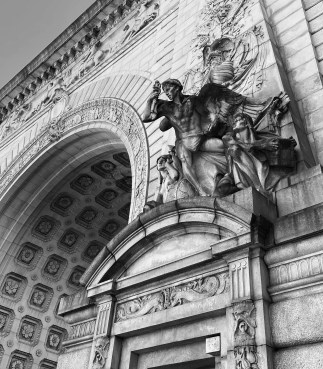
Featured photos taken in the spring of 2023, captured at the Metropolitan Museum of Art and on the Manhattan Bridge.


Andrew, My most favorite so far of your writings. Hits home with me from my early years. I enjoy reading you as I have to do so with a dictionary and google to look up words and people you quote. I like your comment also about Catholic Spirituality. I took some classes at Bellarmine and ended up in a Masters Program of Spirituality that was in conjunction with the Presbyterian Seminary. I wanted to learn more about and try to find God but found myself instead. I’m not Catholic but learned about the beginning of Spirituality and finding God through the Desert Fathers living and worshiping alone in caves. Also the writings of St. Augustan, Thomas Merton, St John of the Cross and a few lady mystics. I still read and research them. Anyway, thanks for this writing. Also I don’t know if you listen to the music of Jim Croce, one of my favorite, but one of his songs sounds like you….New York’s Not My Home
| | | | | |
|
| | | | New York’s Not My Home
|
|
|
Thanks….hope to see you in Florida if you make the family trip to Orlando. Uncle Jimmy
LikeLike